.png?width=159&height=72&name=Curtis%20Power%20Solutions%20(RGB).png)

Power is often easy to overlook when everything is working as you expect. But, for a commercial facility, an outage can quickly affect production, equipment, safety, data, and customer operations.
A reliable commercial power system is crucial to keeping your facility operating when utility power is interrupted. But beyond just looking at the generator size, you need to consider four critical things. How much power your facility uses, which loads are critical, how quickly the backup power must respond, and what the system will cost to operate. This will help you pick the right power generation system for your facility.
In this guide, Curtis Power Solutions outlines seven factors to consider when evaluating commercial power generation systems and related electrical infrastructure.
Why Choosing the Right Commercial Power System Matters
A reliable commercial power system is critical to keeping your facility operating when utility power is interrupted.It should match your facility’s load requirements, operating conditions, and reliability needs while remaining practical to maintain and expand.
Choosing the right power system for your facility can help you do a number of things:
- Reduce the impact of downtime - Keep your critical equipment and operations running when utility power is interrupted.
- Control long-term operating costs - By considering factors like fuel consumption, maintenance, electricity rates, and other lifecycle costs along with the initial equipment price.
- Protect critical equipment - A properly designed system can provide stable backup power and help prevent disruptions to sensitive electrical equipment.
- Prepare for future demand - Through equipment and infrastructure that can accommodate facility expansions, additional loads, or changes in how the building uses power.
The right solution will depend on your facility's specific load profile and operational priorities.
7 Factors to Consider while Evaluating Commercial Power Generation Systems
Choosing the right system requires looking beyond generator size and upfront cost. Factors that you should consider for that include the following:
1. Determine Your Facility’s Power Demand
Start with your actual electrical load rather than estimating based on the size of your building. Review historical utility bills, interval load data, equipment ratings, operating schedules, and seasonal changes in demand.
Pay particular attention to large motors and other equipment with significant starting or inrush loads. A generator may have enough running capacity but still struggle if several large loads start simultaneously. You should add a safety margin of around 10% to 25% to account for this.
Separating essential and nonessential loads can help you size the system more appropriately and avoid paying for unnecessary capacity.
2. Prioritize Power Reliability and Backup Capability
Calculate the potential cost of downtime, including lost production, spoiled inventory, interrupted services, equipment damage, and labor costs. This helps you determine whether a conventional standby generator is sufficient or whether your facility needs a more resilient system.
Response time also matters. A standby generator can typically take several seconds to start and transfer the load. For equipment that cannot tolerate even a brief interruption, a UPS can provide power during the transition.
For critical facilities, the power generation system may therefore combine:
- Standby or prime generators
- Automatic transfer switches (ATS)
- Uninterruptible Power Supply (UPS) systems
- Paralleling switchgear
- Battery or energy storage systems (BESS)
- Remote monitoring and controls
You can also check our guide on NFPA 110 Requirements for Emergency Power to ensure you are equipped to power your hospital, data center, or a mission-critical industry site.
3. Compare Energy Efficiency and Total Operating Costs
The purchase price is only one part of the total cost of your commercial power system. You should look at the full cost of ownership, including fuel, maintenance, service, testing, replacement parts, and expected operating hours before picking your equipment.
Different technologies also make sense under different operating conditions.
-
Combined heat and power (CHP) - CHP generates electricity while capturing heat that would otherwise be wasted. These CHP systems typically achieve total system efficiencies of 65% to 80%, with some systems approaching 90%. CHP is particularly useful if your facility has consistent electrical and thermal loads that can use the recovered heat.
- Solar and energy storage - Solar PV can reduce your reliance on purchased electricity, while energy storage can shift power during peak demand and provide additional resilience.
- Diesel and natural gas generators - Engine-generator systems are commonly used for standby, prime, or continuous applications depending on their configuration and rating. For many facilities, their primary value is reliability rather than replacing grid electricity for every hour of operation.
4. Plan for Scalability and Future Power Needs
Your facility's electrical requirements may look very different five or ten years from now. That’s why it’s important to consider planned expansions, additional production equipment, building additions, electrification projects, and HVAC upgrades before finalizing your system.
This doesn’t mean you should install excess generation capacity today. Instead, look for a system architecture that can be expanded without replacing major components or you may consider Power Generator Rental for your short-term needs.
You can consider options like modular generator configurations, paralleling equipment, expandable switchgear, and additional transfer switches. Your power generation system provider can help you ensure that your equipment can scale as your operations grow.
5. Evaluate Compatibility with Existing Electrical Infrastructure
A generator does not operate in isolation. It has to work with your facility's existing electrical distribution system. That’s why it’s important to check the compatibility of your proposed system before selecting equipment.
Evaluate if it’s compatible with your voltage and phase requirements, main distribution equipment, automatic transfer switches, switchgear, and circuit breakers. You should also determine how power will be transferred during an outage and which loads will receive backup power.
Emergency standby power systems in locations that are seismically active or face high wind loading of up to 150 mph require a special certification and installation process. You can read more about this in our article on Seismic Certification.
6. Review Safety, Regulations, and Maintenance Requirements
Your commercial power equipment needs regular inspection, testing, and maintenance to remain dependable when an outage occurs. Your evaluation should account for applicable electrical, fire, emissions, fuel-storage, and emergency-power requirements.
Common standards and requirements may include OSHA, NFPA 70, and NFPA 70E. Depending on your facility, you might need additional standards or requirements if you run a healthcare facility, data center, or provide emergency services.
You can check our guide on Commercial Generator Rental Safety Checklist to learn what safety measures you need in place before renting your equipment.
7. Choose an Experienced Commercial Power Systems Provider
Besides the equipment, your provider's ability to design, integrate, commission, maintain, and troubleshoot the system can have a major effect on its long-term performance.
Look for a provider like Curtis Power Solutions that can support the complete system rather than supplying a generator and leaving the rest to other contractors. Someone who provides ongoing support for remote monitoring, maintenance, upgrading your equipment, and offers spare parts and accessories too.
You can check our range of Power Generation Equipment and spare parts and discuss what your facility needs.
Commercial Power System Evaluation Checklist
To sum up our discussion, we’ve designed a simple commercial power system checklist to use before selecting or upgrading a system.
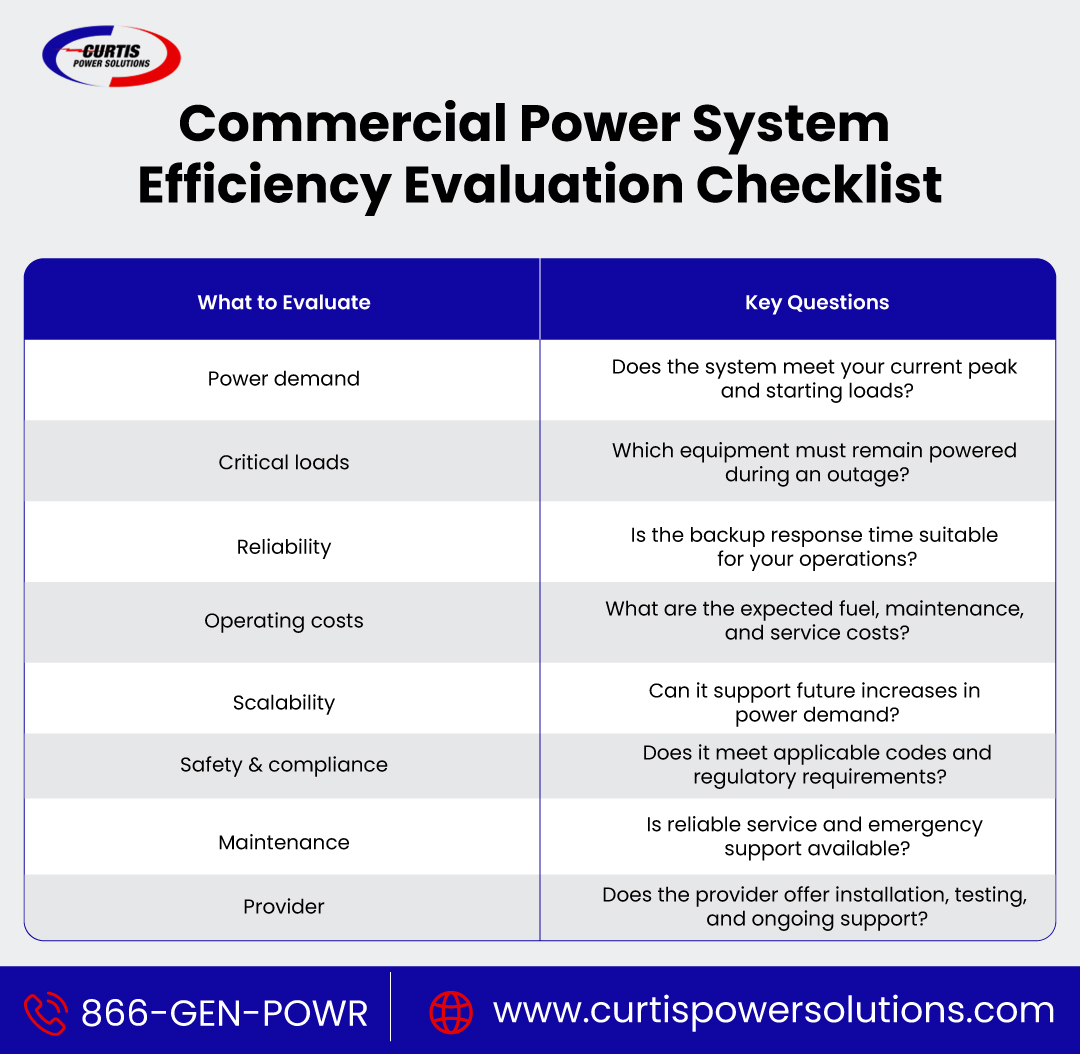
Asking the right questions before selecting equipment can help reduce downtime and ensure your system is properly matched to your facility’s needs.
When Should You Upgrade Your Commercial Power System?
An upgrade may be worth evaluating when your existing system no longer matches your facility's operational requirements.
Common warning signs may include:
- Your facility has added significant electrical loads.
- Your existing generators regularly operate near their capacity.
- Backup power does not cover newly identified critical loads.
- Transfer or startup times are creating operational problems.
- Equipment is becoming difficult to maintain or replacement parts are harder to source.
- Your facility is expanding or adding new electrical equipment.
- Your current system cannot integrate with planned technologies such as CHP, energy storage, or other distributed energy resources.
A load assessment and system review can help you determine whether maintenance, targeted upgrades, additional generation, or a complete system redesign makes the most sense for your facility.
Takeaway
When choosing a commercial power system, you need to look beyond generator size and purchase price.
You need to consider your facility's actual load profile, the consequences of downtime, response requirements, operating costs, future expansion, electrical compatibility, maintenance, and regulatory requirements.
For some facilities, a conventional standby generator may provide the right solution. Others may benefit from a combination of generators, UPS systems, switchgear, CHP, energy storage, or other distributed power technologies. The right approach is to start with the facility's requirements and design the power system around them.
At Curtis Power Solutions, we help commercial, institutional, and government facilities evaluate and implement power generation systems ranging from standby and prime power to CHP and other integrated solutions. Contact Our Team to discuss your needs.
Frequently Asked Questions
1. What should I consider when choosing a commercial power system?
When you’re choosing a commercial power system you should evaluate your total electrical load, the available fuel type, and your system integration needs to ensure reliable operations.
2. How do I determine the power requirements of my facility?
To determine the power requirements of your facility, calculate your total electrical load by conducting an equipment inventory and reviewing past utility bills. Add an additional 25% safety margin.
3. How can commercial power systems improve reliability?
Commercial power systems can improve reliability through technologies such as digital monitoring, IoT sensors, UPS systems, BESS, and factory-tested integrated switchgear, which help facilities detect issues, maintain power continuity, and respond more effectively to outages.
4. Can a commercial power system be expanded as my facility grows?
Many commercial power systems can be designed to support future expansion through options such as additional generation, transfer switches, switchgear, or other electrical upgrades. The best approach depends on the existing system and future load requirements.