When backup power supports a hospital, manufacturing plant, data center, or other critical operation, the generator needs to do more than just provide the necessary wattage. It needs to start reliably, handle your facility's actual load profile, and operate within the conditions of the site.
Choosing an mtu Generator therefore starts with understanding the requirements of your facility rather than simply selecting the largest or the newest model available. This guide from Curtis Power Solutions covers the key factors to consider when selecting an mtu generator for your facility.
Why Choosing the Right mtu Generator Matters
Choosing the right-sized generator is vital because an undersized unit may struggle with starting loads, overload conditions, or future demand. In addition, being significantly oversized can also be inefficient if it routinely operates at very low loads.
The right mtu generator should account for your facility's peak and continuous loads, motor starting requirements, critical loads, operating hours, and future expansion plans.
The application also matters, as a hospital requiring emergency power has different needs from a manufacturing facility using a generator as a prime power source. Understanding these requirements is the first step towards selecting a generator system that fits the way your facility actually operates.
6 Factors to Consider When Choosing an mtu Generator
Consider the following factors when you’re choosing an mtu generator:
1. Determine Your Facility's Power Requirements
Start with your facility’s actual load profile not just its average electricity consumption. Account for peak demand, critical loads, motor-starting requirements, power factor, and any equipment that must operate during an outage. This will help you determine how much generator capacity is needed without unnecessarily oversizing the system.
2. Identify Your Generator Application
Consider how the generator will be used in your facility. A facility may need standby power for emergencies, prime power where utility supply is limited, or continuous power for sustained operation. Your application will affect the generator’s rating, operating profile, controls, and overall configuration.
3. Evaluate the Operating Environment
Site conditions can affect the performance of your generator and its engineering and installation requirements. Consider factors like the ambient temperature, altitude, humidity, dust, corrosive exposure, indoor/outdoor, ventilation, and the space available for installation. These factors can influence the cooling system, enclosure, and generator configuration required for reliable operation.
You can also check our guide to NFPA 110 Installation Considerations for your genset.
4. Consider Fuel and Infrastructure Needs
Evaluate the fuel storage capacity, delivery system, and expected operating hours before choosing a generator. Also plan for exhaust, ventilation, electrical connections, cooling, and maintenance access.
5. Plan for Future Power Requirements
Look beyond your facility’s current demand. New production equipment, HVAC systems, additional buildings, or other electrical loads could increase your future requirements. So, consider expansion or operating multiple units in parallel. For temporary increases in demand or short-term capacity needs, a Generator Rental can also provide additional flexibility while longer-term system upgrades are planned.
Check out our guide on Paralleling Switchgear to learn more about connecting multiple generator units.
6. Consider Parts, Maintenance, and Service Support
A generator is only as reliable as the maintenance and support available throughout its operating life.That’s why, before purchasing, consider whether your mtu generator provider offers preventive maintenance, genuine parts, technician support, testing, troubleshooting, and emergency service. Local support can be particularly important for facilities where extended downtime is costly.
What mtu Generator Size Does Your Facility Need?
mtu organizes its diesel generator sets into series based on power output and application. This includes series 1600, series 2000, and series 4000.
To select the right generator size for your facility, you should begin with a load study to identify the maximum demand the generator must handle. From there, you should consider the starting loads, load acceptance, power factor, duty rating, and any required redundancy.
mtu's current diesel generator portfolio extends across a broad range of ratings, with some Series 4000 configurations reaching 4,000 kVA at 50 Hz and 3,250 kWe at 60 Hz.
You can model your system requirements using the official PS-SPEC Sizing and Specification Program or ask your mtu generator provider for help selecting the right equipment.
mtu Generator Features to Consider
When comparing mtu generator models, look beyond their rated power output. You should consider the following features and options based on your facility’s application:
- Engine series and power rating - Compare the available mtu engine series, output ratings, and duty classifications to find a configuration that suits your facility’s load and operating hours.
- Generator controls - Check the installed control system’s monitoring, alarms, protection, and communication capabilities. Confirm that the available monitoring, alarm, protection, and communication functions meet your facility’s requirements.
- System integration - Verify that the generator controller is compatible with your facility’s building management system, paralleling switchgear, and other power-switching controls.
- Paralleling capability - If you need multiple generator sets to share loads or provide redundancy, check the availability of compatible synchronising and load-sharing controls.
- Cooling configuration - Review the radiator and cooling arrangement against your site’s ambient temperature, altitude, and installation layout.
mtu Generator vs. Other Generator Options
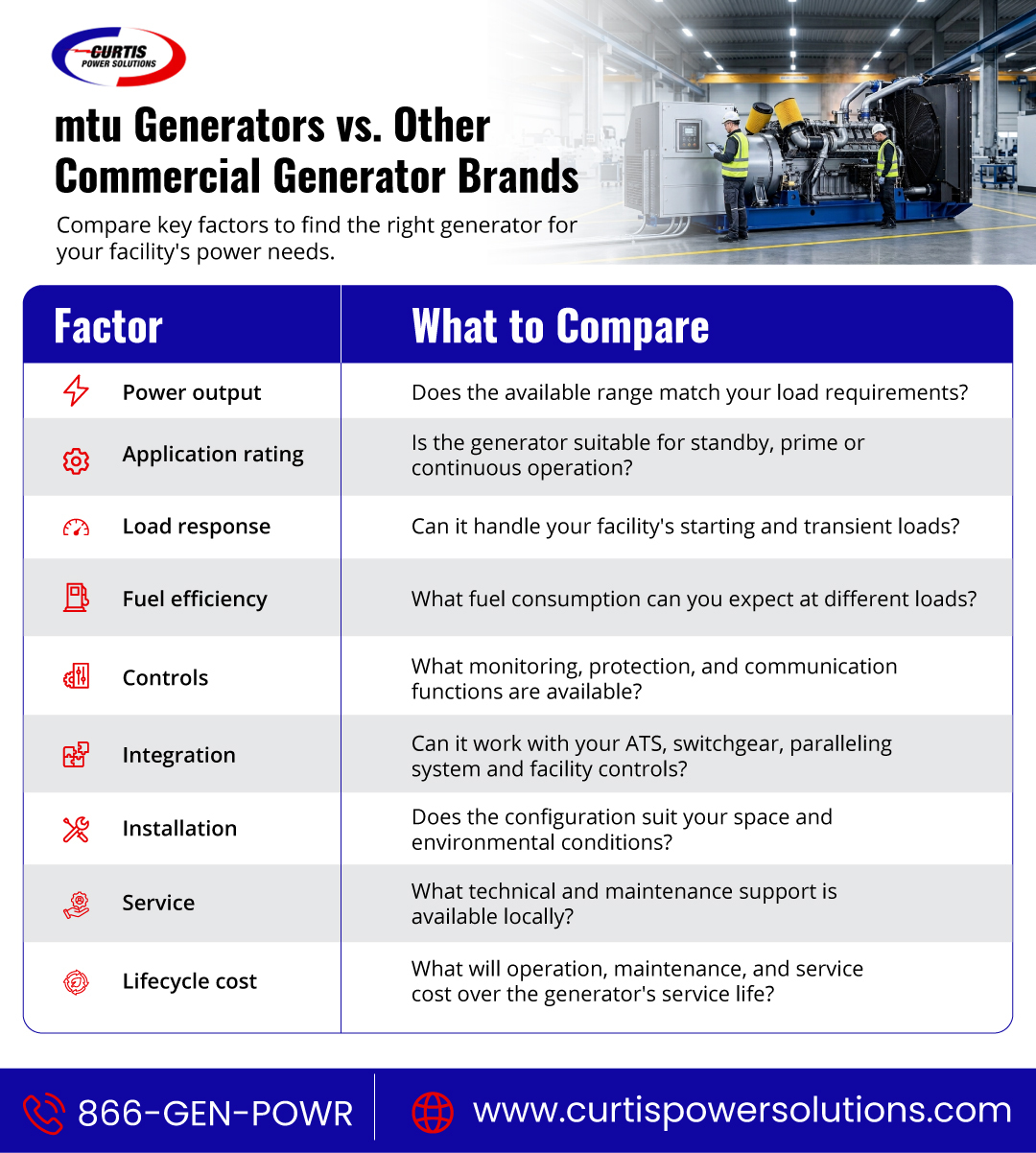
mtu's diesel generator range supports applications including emergency response, healthcare, data centers, airports, wastewater treatment, manufacturing, and independent power stations. However, generator selection should be based on more than brand name alone.You should consider the following points when comparing mtu with other generator manufacturers:
Common Mistakes When Choosing an mtu Generator
Even experienced facility teams can overlook important details when evaluating standby or prime power equipment. Many facilities make similar mistakes when evaluating their requirements, including:
- Choosing based only on average load
Average consumption does not account for peak demand or motor-starting requirements so you should base your generator on the actual load profile.
- Oversizing without understanding the load
A larger generator is not automatically a better choice. If the generator routinely operates at very low loads, its operating efficiency and maintenance requirements need to be considered.
- Ignoring starting loads
Large motors, pumps, and compressors can create significant temporary demand, so include these loads when determining generator capacity.
-
Forgetting future expansion
If you’re planning to expand your facility, consider additional electrical demand before finalizing the generator and switchgear configuration.
-
Treating the generator as a standalone component
The generator is only one part of the power system. Other equipment like ATS, switchgear, controls, fuel systems, exhaust, cooling, and distribution all need to work together.
-
Focusing only on the purchase price
The initial generator cost is only one part of the ownership cost. Maintenance, fuel consumption, parts, service, testing, and downtime all add up over the equipment's service life.
- Leaving installation planning too late
Space, ventilation, exhaust routing, fuel storage, and maintenance access should be resolved during the design stage.
With these considerations, you’ll be better prepared to select the right equipment.
Why Work With a Specialist Provider of mtu Generators?
Choosing the right generator provider is as important as selecting the equipment itself. A specialist provider of mtu generators can not only match the right generator configuration to your facility's power requirements but also to your operating conditions and long-term plans.
They can guide you through capacity selection, application ratings, control systems, and integration with existing electrical infrastructure. They may also coordinate installation, commissioning, maintenance, and replacement parts.
At Curtis Power Solutions, we offer mtu power generation equipment sales, rentals, parts, and mission-critical design across the Mid-Atlantic states. Contact Curtis Power Solutions for support specifying the right generator system and planning for ongoing service and maintenance.
Frequently Asked Questions
1. How do I determine what size mtu generator I need?
To find the right sized mtu generator, factor in what equipment you may need during an outage, add their running loads, and the highest starting load of a single motor-driven equipment. You should also add in a safety margin of 20-25% to this calculated load.
2. Are mtu generators highly suitable for commercial facilities?
Yes. mtu generators are available for a range of commercial and industrial applications, including standby and prime power.
3. Can an mtu generator support future facility expansion?
Yes, depending on the system design. Future expansion can be supported through proper generator sizing, paralleling capability, and system planning.
4. What is the difference between standby and primary power?
The main difference between standby and primary power is in their runtime and operational use. Primary power is used as the main power source where utility grid power is missing/unreliable, operating for many hours per year. Standby power, on the other hand, acts as an emergency backup system with limited operational hours.
5. How often does an mtu generator require maintenance?
The maintenance requirements for mtu generators vary based on the mtu generator model, operating hours, load profile, and site conditions. They generally require an annual maintenance or roughly after 100-250 operational hours.
6. Where can I get mtu generator parts and service?
You can get mtu generator parts and service from the official mtu Solutions Sales & Service Locator or their authorized regional distributors, including Curtis Power Solutions.