.png?width=159&height=72&name=Curtis%20Power%20Solutions%20(RGB).png)

Emergency generator rentals provide temporary backup power during outages, disasters, maintenance, and unexpected disruptions, helping businesses maintain critical operations and minimize downtime.When the power goes out suddenly, managing industrial applications, construction sites, hospitals, and data centres becomes difficult. A prolonged outage can interrupt production, affect critical equipment, disrupt communications, and create safety concerns.
An emergency power generator rental saves the day in such cases by offering power backup to keep your essential operations running while your utility power gets restored.
If you’re wondering how to rent the right sized emergency power generator, how much it’ll cost, and what safety considerations it needs, then this guide by Curtis Power Solutions is for you.
What Is Emergency Power Generator Rental?
An emergency power generator rental is a temporary power system that you bring to your facility or job site when your normal power supply is unavailable or insufficient.
Unlike a permanent standby generator, you can use this rental generator for a specific period and remove it once the need has passed. This allows you to fulfill additional power needs without purchasing another permanent genset.
When Do You Need Emergency Power Rental?
Temporary emergency power becomes important when an outage affects systems that cannot simply be shut down until the utility service returns.
Such situations where you may need an emergency generator rental include:
- Natural disasters - Severe storms like hurricanes, ice storms, tornadoes, or floods can knock out your main power supply for days or weeks.
- Grid failures - Rolling blackouts or unexpected utility supply failures force businesses offline without backup.
- Equipment maintenance - Scheduled or emergency downtime of a facility's main generator, internal substation, or heavy electrical gear.
- Critical load support - Protecting essential systems in hospitals, data centers, restaurants, and offices from catastrophic financial or operational loss when the power goes out.
You can also check our detailed guide on which industries need power generator rental to ensure continued operations.
How to Choose the Right Emergency Generator Rental
Choosing an emergency generator isn't simply about finding the largest unit available. The generator needs to match the electrical and physical requirements of your site.
You should consider factors like:
-
Required power output - Determine the total load that needs to be supported.
-
Critical loads - Identify which systems must remain operational and which can be switched off.
-
Starting loads - Motors, pumps, compressors, and other equipment can require more power during startup.
-
Voltage and phase - The generator must be compatible with the electrical requirements of the equipment being powered.
-
Fuel availability - Consider whether diesel or another fuel source is practical for your site and expected runtime.
-
Runtime - Longer outages require appropriate fuel storage and refueling plans.
-
Site access - Make sure there is enough room and suitable access for delivery, placement, cabling, and servicing of the genset.
-
Distribution requirements - Large facilities may need temporary distribution panels, transformers, switchgear, or other equipment.
-
Installation and support - Consider who will handle setup, connection, monitoring, maintenance, and refueling.
You can also read our guide for a comparison into diesel vs gas generators to help you choose the right fuel type.
What Size Emergency Generator Do You Need?
Choosing the right sized power generator rental is crucial. An undersized generator may not be able to handle the required load and can become overloaded when additional equipment starts.
Start by identifying which equipment needs emergency power and determine its electrical requirements. You then need to account for both running loads and starting loads, particularly for motor-driven equipment.
You should also consider whether additional equipment could need power during the outage. But remember, oversizing a generator unnecessarily can increase rental, fuel, and operating costs.
For complex commercial or industrial applications, you can seek support for professional load assessment to determine the appropriate generator capacity and configuration you need.
Benefits of Emergency Power Generator Rental
Emergency generator rental can offer several advantages when permanent power is unavailable. The list of benefits that you get from using an emergency power rental includes:
- Fast access to temporary power - A rental allows you to obtain generating capacity without waiting for a permanent generator to be purchased and installed.
- Reduced operational downtime - Keeping your essential systems running can help reduce the disruption caused by an extended outage.
- No permanent investment on equipment - If the need is temporary, renting allows you to access the required capacity without purchasing costly new equipment.
- Flexible capacity - You can scale your equipment based on your specific requirements rather than being limited to the capacity of a permanent generator.
- Support during generator repairs - An emergency rental generator can provide temporary backup while your permanent generator is being repaired, tested, or replaced.
- Professional technical support - Depending on the rental provider and agreement, temporary power services can include delivery, setup, maintenance, monitoring, and emergency technical support.
Emergency Power Rental vs. Buying a Generator
The choice between an emergency power rental or purchasing one comes down to how often you need the equipment and how long you expect to use it.
We’ve tabulated some factors below that you should compare before choosing a rental vs buying a generator. 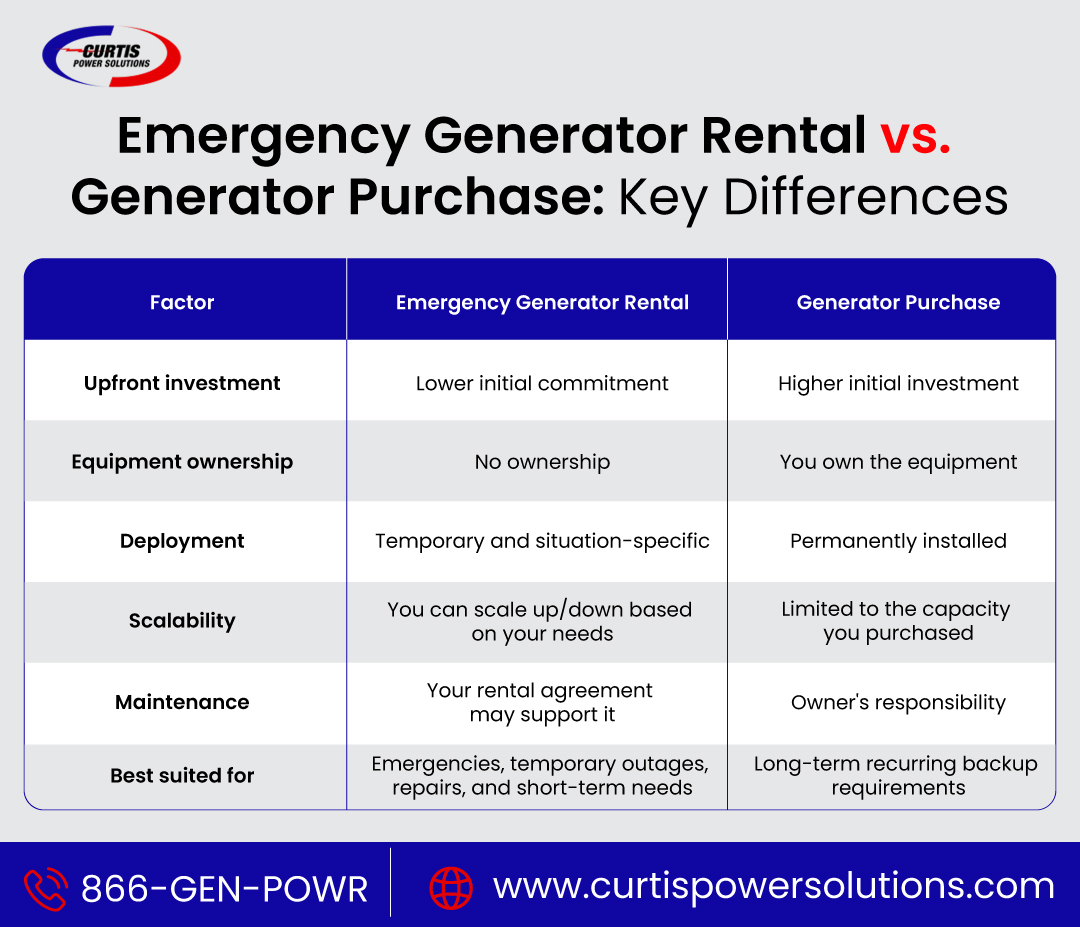
What Is Included With an Emergency Generator Rental?
An emergency power rental may include more than just the generator itself. Depending on the provider and application, your emergency rental package may include generator delivery, equipment setup, electrical distribution equipment, power cables, transformers or other accessories, and fuel tanks and fuel management.
Your generator rental provider may also offer additional support for routine maintenance, remote monitoring, emergency technical support, and equipment pickup after your rental period is over.
The exact scope of your rental services varies by project, so it’s important that you review your rental agreement carefully before the equipment is dispatched.
Safety Considerations for Emergency Generator Rentals
Emergency situations can create pressure to restore power as quickly as possible. But this doesn’t mean you should forgo appropriate safety practices for generator installation and operation.
Here are some important safety considerations that you must keep in mind while setting up a rental generator:
-
Provide adequate ventilation - The generator exhaust contains carbon monoxide (CO), a colorless and odorless poisonous gas. That’s why they should always be positioned outdoors and away from doors, windows, vents, and other openings through which exhaust could enter a building.
-
Protect against electrical shock - Generators produce electricity with the same fundamental electrical hazards as utility power. Wet conditions, damaged cables, improper grounding, and incorrect connections can increase the risk of electric shock or electrocution.
-
Prevent electrical backfeed - Never connect a generator directly to a building's electrical system without the appropriate transfer equipment and qualified installation. Backfeeding can energize utility lines that your workers may believe are de-energized.
-
Manage fuel safely - Fuel should be stored and handled appropriately for the generator and site. You should shut down the generator and allow it to cool before refueling to reduce the risk of fire.
-
Avoid overloading the generator - The generator should be operated within its rated capacity. You should also monitor the loads throughout operation, particularly when additional equipment is brought online.
For complex temporary power installations, you should work with qualified professionals who understand the electrical, fuel, ventilation, grounding, and site requirements involved.
At Curtis Power Solutions we offer generator installation services along with maintenance, remote monitoring, and suggest you the right equipment based on your needs. Get in touch with our team to discuss your power requirements.
How Much Does Emergency Generator Rental Cost?
There isn't a standard price for emergency generator rental. The cost depends on the equipment and services required for your particular situation.
The factors that can affect your emergency power rental cost include:
- Generator size and power output
- Rental duration
- Emergency or after-hours deployment
- Delivery distance
- Installation and connection requirements
- Fuel consumption and refueling needs
- Transformers and accessories
- Monitoring and maintenance
- Site access and setup requirements
The best way to get an accurate estimate is to provide your rental provider with complete information about your facility, required loads, location, expected runtime, and connection requirements.
Why Choose Curtis Power Solutions for Emergency Generator Rental?
When your power is already out, you need more than a generator, you need a temporary power solution that can be deployed and supported throughout the outage. At Curtis Power Solutions, we help businesses with generator rental and emergency power support.
Our services include emergency response, generator maintenance, and support for temporary power requirements. We also offer 24-hour emergency services and wirelessremote monitoring through Curtis On Call and Power Connect.
Curtis can also help you evaluate your temporary power requirements, select appropriate equipment, and coordinate the supporting services you need to keep your facility operating. With us your emergency power response is more organized and reliable.
Takeaway
An emergency power generator rental can help you provide temporary electricity when your normal power supply or permanent backup system isn't available.
But the right solution depends on more than just the generator size, you also need to consider your critical loads, starting requirements, fuel supply, electrical connections, site conditions, and expected runtime.
By working with an experienced rental provider, you get the support not just for selecting the appropriate equipment but to keep it running efficiently too. Contact Curtis Power Solutions for your emergency or temporary power needs.
Frequently Asked Questions
1. How big of a generator do I need for emergency power?
To know your accurate emergency power needs, make a list of equipment that you need, add all their running wattages, and add the highest starting wattage to it. For a safe margin, you can add an additional 20 % capacity.
2. How long can an emergency generator run?
Portable generators can run for 8 to 12 hours continuously on a single tank of gas while standby generators can run from 50 to 200 hours before they need a mandatory oil check or service.
3. How quickly can an emergency generator be delivered?
Emergency generator rentals are usually delivered and set up in 2-4 hrs locally or on the same day. If you’re purchasing a large standby generator, it can take up to a week to reach depending on the distance to your location.
4. Can an emergency generator power an entire facility?
Yes, an emergency generator can power your entire facility depending on its capacity and how your building's electrical system is designed.
5. Does generator rental include delivery and setup?
Whether a generator rental includes delivery and setup depends on the provider you choose and the size of your generator.
6. What is an emergency power generator rental?
An emergency power generator rental offers power backup in case of an unexpected utility failure, natural disaster, or your primary system breaks down.